
Most document problems don't come from a missing document. They come from the right document in the wrong version: a certificate apostilled in the wrong place, a translation the receiving authority won't accept, or a record in a format the process doesn't expect.
That's why every request we handle starts with one question: what is this document for? The country, the process and the authority that will receive it shape which version is ordered, which apostille it needs and whether it needs a certified translation.
Why "the same document" is often three different documents
A birth certificate may need a different version, apostille or translation for a citizenship file in Italy, a visa in the US or a company opening in Spain. The record is the same; the destination changes what the receiving authority expects.
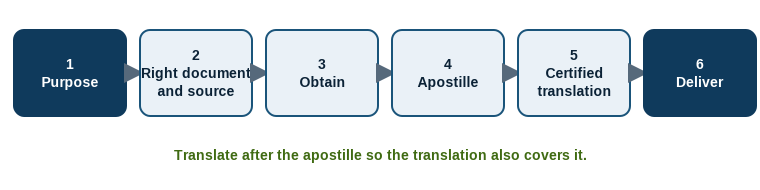
The questions to ask before ordering anything
Start with the destination, not the document:
- Who will receive the document, and in which country?
- What is the procedure: citizenship, residency, visa, hiring, investment or a corporate filing?
- Who is the document about, and how are their names written across records?
- Which version is expected: short form, long form, full content, certified copy or original?
- Does it need an apostille or legalization?
- Does it need a translation, and into which language?
- Are there recency rules?
- Where and how should it be delivered?
Our document checklist turns these questions into a working tool.
Where requests usually go wrong: version, apostille, translation
Version: a short-form certificate where a full-content version is expected. Apostille: issued by the wrong authority, for example a state office for a federal document. Translation: one the receiving authority does not accept, or one made before the apostille, so it does not cover it.How purpose-first changes the way a partner's team works
When the purpose is captured at intake, the right version, authority and sequence are confirmed before anything is ordered. In our experience, that is what keeps a file from starting over. It also gives the team one clear answer to give the client, instead of several partial ones.
This article is general information for teams that handle international documents. It is not legal advice, and CrossContinental Advisors is not a law firm. Requirements vary by destination country, process and receiving authority.